
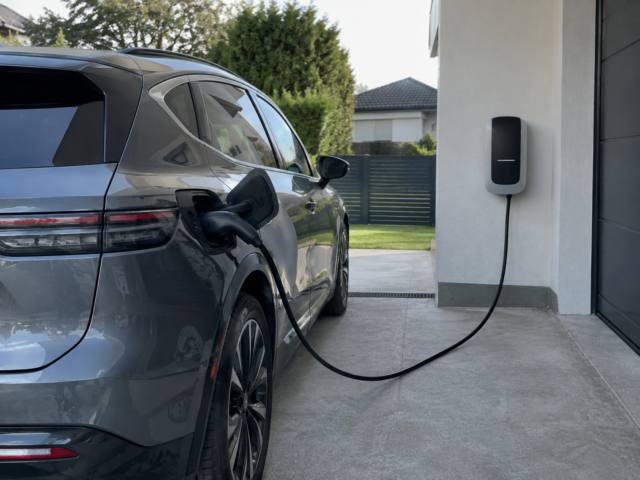
Yes, a home with a 100 amp electrical service can sometimes support an EV charger. The answer depends on the home’s existing calculated load, the charging current you want and whether an approved load management system is used. An empty breaker space does not prove that the service has enough electrical capacity. The correct way to answer this question is to look at the home’s electrical loads and perform an applicable dwelling load calculation. There is also an important distinction between a 100 amp panel and a 100 amp service.
Homeowners often use those terms interchangeably. The panel board itself may have a rating that is different from the actual electrical service rating. When deciding whether an EV charger can be added, the service capacity and calculated load are what matter.
100 Amp Service + EV Charger Capacity Example
100 Amp Service + EV Charger Capacity Example
See how a sample 100 amp home changes when EV charging is added. This interactive example is for education only. It does not replace a real dwelling load calculation for your home.
Show sample home details
Estimated result
This is an educational example. A positive margin does not automatically mean an EV charger can be installed. Final service capacity and branch-circuit requirements should be verified for the actual home.
How this example works
This example compares a sample home’s estimated service load with the capacity of a 100 amp 120/240 volt service. Because 100A x 240V = 24,000 VA, the total estimated load can be compared with 24,000 VA to show whether there is arithmetic margin, very little margin or an overage. This is an educational example and not a substitute for a load calculation for your actual home.
Use our Electrical Panel Load Calculator with your actual appliances and EV charger size.
Use the Electrical Panel Load CalculatorUse the interactive example above to see how major appliances and different EV charging rates can affect a sample 100 amp home.
A 100 Amp Service Does Not Mean Your Home Is Using 100 Amps.
A common misunderstanding is that a 100 amp service means the house is already using close to 100 amps.
That is not how residential electrical systems normally work.
A home may have many circuits and the total of all breaker ratings can be much higher than the service rating.
This is possible because not every electrical load operates at maximum power at the same time.
The National Electrical Code uses load calculations and demand factors to estimate how much capacity a dwelling service needs.
That means you cannot determine available capacity simply by adding up the numbers printed on the breakers.
Empty Breaker Space Does Not Mean You Have Available Capacity.
This is one of the most important things for homeowners to understand.
You might open your electrical panel and see two empty spaces.
That tells you something about physical space inside the panel.
It does not tell you how much electrical capacity remains on the service.
Think of these as two separate questions.
Breaker space
Is there physical room for another breaker?
Service capacity
Can the electrical service support the additional calculated load?
You can have empty breaker spaces and still have very little available service capacity.
You can also have a physically full panel while the dwelling still has electrical capacity. A qualified electrician may have other code-compliant options depending on the installation.
Breaker Space vs Available Service Capacity
An empty breaker position tells you there may be physical room for another circuit. It does not tell you whether the electrical service has enough calculated capacity for that new load.
Panel space asks whether the panelboard has a usable breaker position. Service capacity asks whether a proper load calculation shows enough electrical capacity for the proposed load.
Physical panel space
Schematic only. Breaker layout and permitted circuit configurations depend on the actual panelboard listing and labeling.
Calculated service load
How the examples are calculated
This diagram starts with a hypothetical dwelling load that has already been determined by a proper load calculation. It does not add breaker handle ratings together. The example then divides volt-amperes by 240 V to show the equivalent calculated current.
Example: 21,600 VA / 240 V = 90 A. For this 120/240 V single-phase example a 100 A service rating can be expressed as 24,000 VA for arithmetic comparison. This does not create a separate NEC capacity allowance or an 80 percent or 90 percent pass or fail threshold.
Actual dwelling service calculations use NEC demand factors and installation-specific loads. The calculation method depends on the adopted code edition and the installation. The service equipment rating, bus rating, conductor ampacity and other requirements also need to be verified.
Why a full panel can still have service capacity
A panelboard can have every breaker position occupied while the dwelling calculated load remains below the service rating. That does not mean another breaker can simply be added. Any change must comply with the panelboard listing and labeling and the applicable electrical code. Depending on the installation a qualified electrician may consider a listed subpanel or another code-compliant solution.
Why empty spaces can still mean no room for a large new load
A panel can have empty breaker positions while the dwelling service load is already close to the service rating. Physical space alone does not establish that an EV charger or another major load can be added. The proposed load needs to be included using the applicable service or feeder load calculation or another method permitted by the adopted code.
Use the Electrical Panel Load Calculator with your actual dwelling information. Do not rely on empty breaker positions as proof of available capacity.
Use the Electrical Panel Load CalculatorEducational illustration only. The arithmetic difference shown is not an NEC approval threshold. Do not remove panel covers or modify electrical equipment to use this diagram. Final service capacity and any new circuit should be evaluated for the actual installation by a qualified person and the AHJ where required.
This distinction becomes especially important with EV charging because a Level 2 charger can represent a significant new electrical load.
How Much Power Does an EV Charger Use?
Home Level 2 EV charging equipment is available at several current ratings.
Common charging settings include:
- 16 amps
- 24 amps
- 32 amps
- 40 amps
- 48 amps
EV charging is treated as a continuous load for branch-circuit sizing.
As a general rule, the branch circuit and overcurrent protection must be sized for at least 125 percent of the maximum EVSE load.
Do You Actually Need a 48 Amp EV Charger?
Not necessarily.
It is easy to assume that buying the fastest home charger is always the best option.
For many drivers that is not required.
A 48 amp EVSE can deliver about 11.5 kW at 240 volts.
A 32 amp EVSE can deliver about 7.7 kW.
A 24 amp EVSE can deliver about 5.8 kW.
The right charging rate depends on factors such as:
- How many miles you normally drive each day
- How large the vehicle battery is
- How efficiently the vehicle uses energy
- How many hours the vehicle is parked overnight
- How much electrical capacity is available
If your car normally sits in the garage for 10 hours every night, you may not need the maximum charging rate that the vehicle can accept.
A lower charging current can sometimes make EV charging easier to accommodate on an existing 100 amp service.
Frequently Asked Questions
Can a 100 amp service charge an electric car?
Yes. Many electric vehicles can be charged at homes with 100 amp electrical service. The permitted charging setup depends on the dwelling load calculation, EVSE rating and applicable code requirements.
Do I need a 200 amp panel for Level 2 EV charging?
Not automatically. Level 2 EV charging can be installed on some 100 amp and 150 amp services. A load calculation is needed to determine the available capacity.
Does an empty breaker space mean I can install an EV charger?
No. An empty breaker space indicates physical room for a breaker. It does not prove that the electrical service has enough capacity for the additional EV charging load.
Is a 48 amp EV charger too large for a 100 amp service?
It can represent a substantial load on a 100 amp service. Some installations may accommodate it while others may need a lower charging setting, approved load management or a service upgrade.
Can an EV charger reduce its power when my house is using more electricity?
Some approved EV charging and power management systems can limit charging based on available electrical capacity. The system must be suitable for that purpose and installed according to the applicable code requirements and equipment instructions.
Is the DIY Tech Vault Electrical Panel Load Calculator a replacement for an electrician?
No. It is a planning and educational tool. Final service capacity, conductor sizing, overcurrent protection, equipment requirements and local code compliance should be verified for the actual installation.