
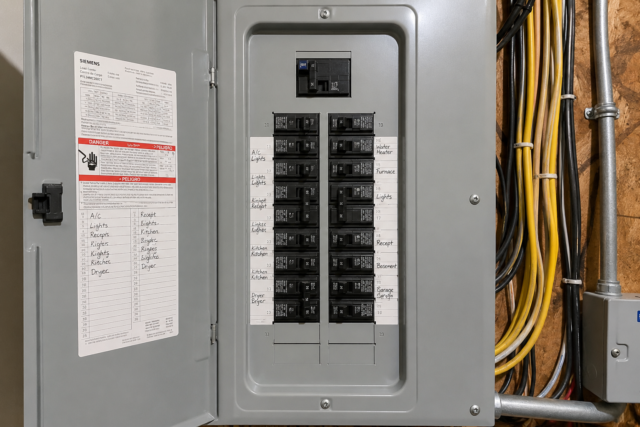
Your breaker box is the nerve center of your home’s power. Here’s what every label, number, and component actually means and what electricians look for the moment they open the door.
Most homeowners open their electrical panel only when something goes wrong — a tripped breaker, flickering lights, or a new appliance that won’t fire up. But electricians read a panel the way a doctor reads a chart: systematically, looking for patterns, and always watching for warning signs. Once you know what you’re looking at, your breaker box tells a complete story about your home’s electrical health.
What the Electrical Panel Actually Is
The electrical panel also called a breaker box, load center, or distribution board is the point where electricity enters your home from the utility company and gets divided into individual circuits. Power arrives through two large hot wires (each carrying 120 volts) and one neutral wire, delivering a combined 240 volts of service. Everything inside the panel is built around managing and protecting that incoming power as it splits off to serve your lights, outlets, appliances, and HVAC systems.
Think of it less like a simple on/off switch and more like a traffic junction. The panel doesn’t create power it routes it safely, enforces limits on each path and automatically shuts down any circuit that draws more current than it was designed to handle.
Explore Your Electrical Panel
Tap or click a numbered area to learn what each part does.
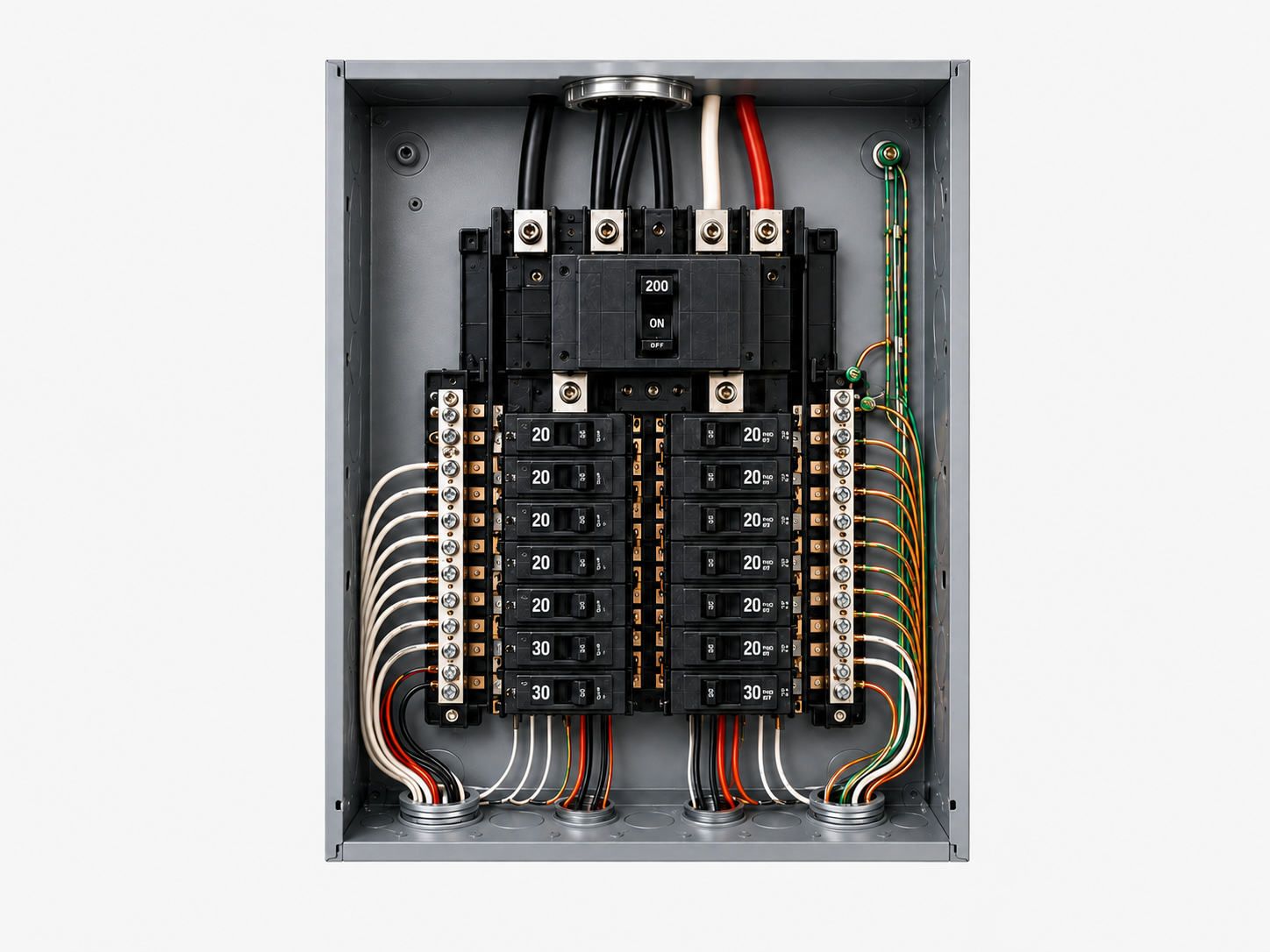
Tap a numbered area
Explore the panel by tapping the main breaker, branch breakers, conductors, neutral bar, ground bar, or bus bars.
The Main Breaker: The Master Switch
At the very top of your electrical panel sits the main breaker a large double-pole breaker typically rated between 100 and 200 amps. This single breaker controls all power entering your home. When an electrician needs to work on any part of the panel, the main breaker goes off first. It's the only way to de-energize the bus bars below it.
The amperage rating stamped on this breaker tells you your home's total service capacity. A 100-amp panel was common in homes built before the 1980s. Most modern homes run on 200-amp service. If yours is still at 100 amps and you're adding an EV charger, a hot tub or major appliances, updating your electrical panel is likely in your future.
Safety note: The wires feeding into the main breaker from above — the service entrance conductors — are always live, even when the main breaker is off. Only the utility company can de-energize those. Never touch them.
Bus Bars: Where the Power Gets Distributed
Running vertically down the center of the panel are two metal bars called bus bars. Each one carries 120 volts from one of the two incoming hot wires. Individual circuit breakers clip onto these bars left column breakers connect to one bar, right column to the other. This alternating layout is why electricians count breaker slots in pairs.
For standard 120V circuits, a single-pole breaker clips to just one bus bar. For 240V circuits like a clothes dryer, electric water heater or HVAC system a double-pole breaker clips to both bars simultaneously, drawing from both legs and delivering the full 240 volts the appliance needs.
Reading Individual Circuit Breakers
Each breaker has an amperage rating stamped directly on its toggle, typically 15A, 20A, 30A, or 50A. This number isn't the amount of power the circuit uses; it's the maximum safe load before the breaker trips. A 15-amp breaker protects 14-gauge wire. A 20-amp breaker is paired with 12-gauge wire. Mismatching these is a serious fire hazard, which is why a licensed electrician never replaces a circuit breaker with a higher-rated one just to stop it from tripping.
The Neutral Bar and Ground Bar
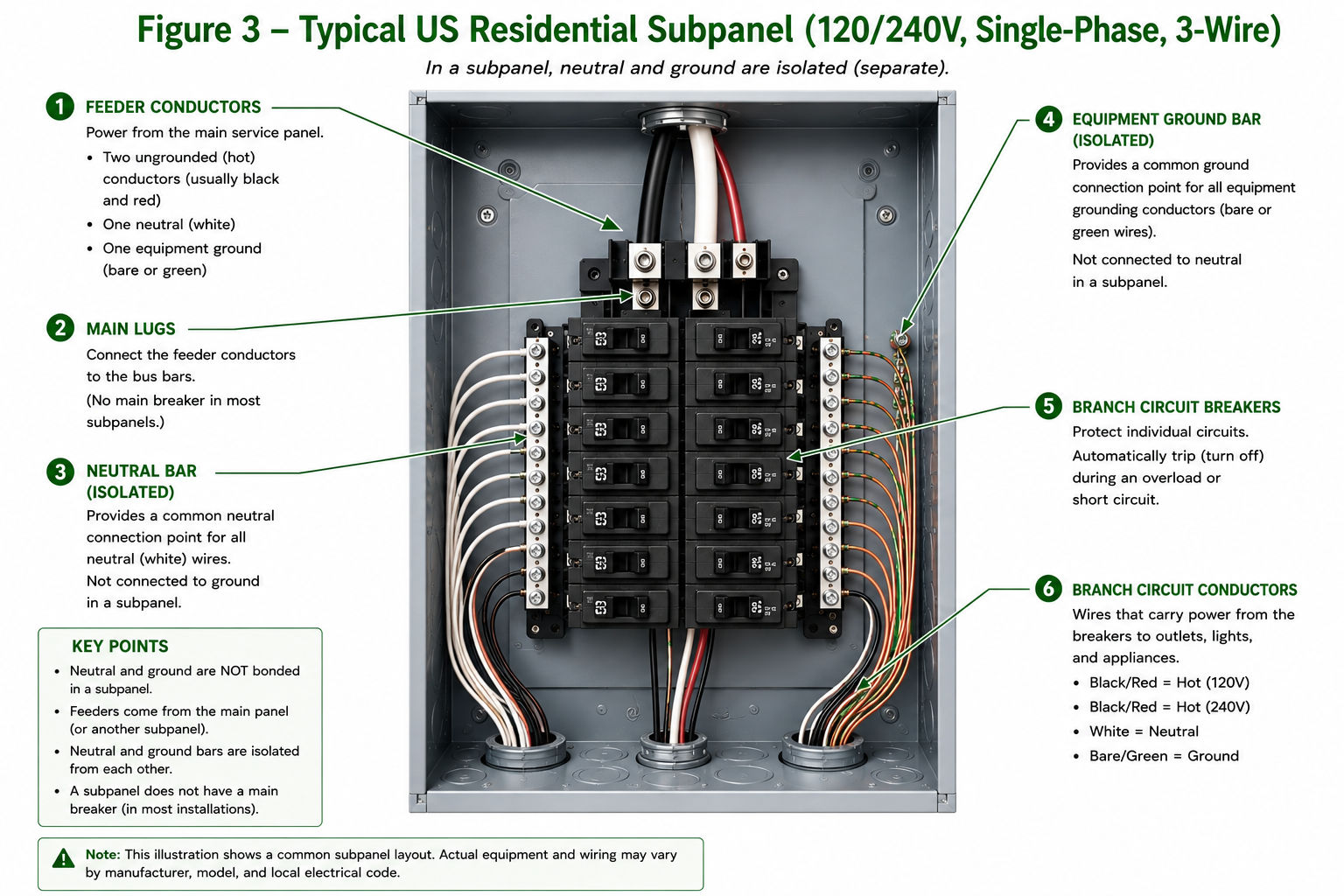
On one side of the panel you'll find the neutral bar a metal strip where all the white (neutral) wires terminate. On the other side, or sometimes combined in older panels, is the ground bar where bare copper or green wires connect. In the main electrical panel, neutral and ground bars are often bonded together. In a sub panel, they must be kept separate a code requirement many DIYers get wrong.


What Is a Sub Panel?
A subpanel is a secondary distribution panel fed from the main electrical panel, typically used to service a detached garage, workshop, addition, or basement. It receives power through a dedicated double-pole breaker in the main panel often called a feeder breaker and then distributes that power to its own set of circuits.
The critical difference when reading a sub panel: the neutral bar and ground bar must be separate and must not be bonded together. The bonding point is always at the main panel only. Confusing this distinction is one of the most common code violations electricians find during inspections.
Safety first: If you open your panel and see scorch marks, melted plastic, a burning smell, or breakers that feel warm to the touch, close the door and call a licensed electrician immediately. These are signs of a serious problem — not a DIY situation.
When to Replace a Circuit Breaker
Breakers are designed to last, but they do fail over time. Signs that you may need to replace a circuit breaker include a breaker that trips repeatedly under normal load, one that won't reset after tripping, a breaker that feels hot or shows physical damage or a breaker that doesn't click firmly into the on position. Replacing a single breaker is one of the more straightforward electrical tasks but it still requires turning off the main breaker and understanding which wires attach where before proceeding.
Never replace a breaker with a different brand than the panel manufacturer without verifying compatibility. Breakers are not universally interchangeable and using an incompatible breaker can create a dangerous installation even if it physically fits.
Is It Time to Consider Updating Your Electrical Panel?
Updating your electrical panel makes sense in several situations: your current panel is at capacity with no open slots, your home still has a Federal Pacific or Zinsco panel (both known for reliability issues), you're adding high-draw appliances like an EV charger or home battery system or your electrician has flagged safety concerns during an inspection. A panel upgrade typically moves a home from 100-amp to 200-amp service, rewires the service entrance and installs a new load center with modern breaker slots and updated grounding.
It's not a glamorous upgrade you won't see it like new flooring or a kitchen renovation but updating an electrical panel is one of the most impactful safety improvements a homeowner can make. It often reduces homeowner's insurance premiums and is frequently required before selling a home in many markets.
Frequently Asked Questions
Is a breaker box the same as an electrical panel?
Yes. Breaker box, electrical panel, load center, fuse box (in older homes), and distribution board are all names for the same thing the metal enclosure where electricity enters your home and gets divided into individual circuits. Electricians most commonly call it a panel or load center. Homeowners tend to say breaker box.
What is the main electrical box in a house called?
The main electrical box is called the electrical panel, service panel or load center. It's also commonly referred to as the breaker box or circuit breaker panel. The large breaker at the top the one that controls all power entering the panel is called the main breaker. Together, the enclosure and everything inside it make up what most people mean when they say "the electrical panel."
How do I know if my electrical panel is full?
Open the panel door and count the empty breaker slots. If every slot has a breaker in it and there are no open spaces, the panel is full. Some panels appear full but have tandem breakers (two thin breakers sharing one slot) check your panel's label to see if tandems are approved and how many are allowed. If your panel is full and you need a new circuit, you'll need either a panel upgrade or a sub panel added.
Does homeowners insurance cover electrical panel replacement?
It depends on the reason for replacement. If your panel was damaged by a sudden, covered event like a lightning strike, fire, or power surge most homeowners insurance policies will cover the replacement cost, minus your deductible. However, if the panel needs replacing due to age, wear, outdated equipment (like a Federal Pacific or Zinsco panel) or general deterioration, insurance will not cover it. That's considered a maintenance issue, which falls on the homeowner. Always check your specific policy and call your insurer before assuming coverage.
Can I upgrade my electrical panel without rewiring my house?
In most cases, yes. A panel upgrade replaces the main electrical panel and service entrance it does not automatically require rewiring the circuits throughout your home. The existing branch circuit wiring stays in place as long as it's in good condition and up to code. However, if an electrician finds outdated wiring during the upgrade (such as aluminum branch wiring or cloth-insulated knob-and-tube wiring), they may recommend rewiring those circuits separately. The panel upgrade and a full rewire are two distinct projects with very different costs. To calculate or determine how much an upgrade is needed use this calculator link to determined.
Check out the interactive electrical panel if you want learn more by clicking here.